
The Definitive Guide to Building Authentic Brands for Developer Tools, APIs, and B2B SaaS
Search interest in vibe marketing increased 686% over 12 months. Companies like Notion, Linear, and Figma built cult followings. The advice is everywhere.
Salesforce tells you vibe marketing is about “creating an emotion around a brand rather than explicitly promoting specific products.” Exploding Topics positions it as an AI tool trend to slash marketing costs. DigitalFirst.ai frames it as multi-channel automation.
All focused on consumer products or horizontal SaaS. Beautiful interfaces. Emotional resonance. Social media vibes.
But what if you’re building infrastructure? A database. An API. Developer tools. DevOps platforms.
For technical products, vibe has nothing to do with color palette or tone of voice. It comes down to whether your systems actually work together.
Technical buyers smell this chaos instantly. They walk.
If you’re selling APIs, automation, or operational efficiency, your marketing vibe isn’t created by brand guidelines. It’s created by whether your operational reality matches your marketing promises.
This guide covers:
How to create “vibe” for technical products where the vibe isn’t aesthetics – it’s operational coherence. Why developers trust Stripe but ignore your “seamless integration” claims.
The 3 pillars of operational vibe that technical buyers evaluate before your demo. How to build marketing systems that signal competence, not chaos. Why does this create a competitive advantage that your competitors can’t copy?.
Written from a technical founder perspective. No marketer-to-marketer theory. Just what actually works when you’re selling to people who build systems for a living.
- For technical products, vibe isn’t aesthetics. It’s whether your demo works, documentation is current, and promises match operational reality.
- Developers influence 73% of enterprise software decisions and detect system chaos instantly.
- Your marketing vibe is your operational coherence made visible.
- The 3 pillars: connected systems, consistent execution, and authentic positioning.
- Stripe, Twilio, and MongoDB built billion-dollar platforms through operational vibe, not aesthetic campaigns. Operational coherence is harder to copy than product features.
What vibe marketing actually means for technical products
While Salesforce positions vibe marketing as emotional brand building, Exploding Topics sells it as an AI tool stack, and technical products need something different.
For technical products, your vibe is your operational reality made visible.
It’s whether your demo actually works when the prospect clicks through. Whether your API documentation was updated when you shipped v3.2 last week. Whether your support team responds in hours, not days. Whether prospects can tell you that you actually use your own tools.
Technical buyers – CTOs, VPs of Engineering, senior developers – evaluate your operational coherence before they evaluate your features. They’re pattern-matching. If they can’t keep their docs up to date, how current is their codebase? If their marketing tools don’t talk to each other, how will their product integrate with mine? If support is slow, what happens when production breaks?
This is why Stripe won the payments despite dozens of competitors. They didn’t have better features – they had better operational vibe. Documentation that’s actually current. SDKs that work. Support that responds. High-quality documentation correlates with 5x higher adoption rates.
The pattern: Companies that win technical markets – Stripe ($95B), Twilio ($21B), MongoDB ($35B), GitHub (100M+ developers) – built operational vibe first, aesthetic second.
Why most vibe marketing advice doesn’t work for technical products
The disconnect is simple:
Most vibe marketing content targets B2C or horizontal B2B. The advice assumes your buyer responds to emotional resonance, aesthetic consistency, and cultural relevance. And for consumer products, that’s correct.
But technical buyers are different. Developers have significant influence in 73% of enterprise software purchase decisions. And 42% of enterprise SaaS deals now start with developer adoption, not top-down procurement.
These buyers evaluate differently:
| Consumer/Horizontal SaaS | Technical Products |
|---|---|
| Emotional resonance | Operational evidence |
| Aesthetic consistency | Documentation quality |
| Cultural alignment | Technical credibility |
| Brand storytelling | System reliability |
| Social proof via influencers | GitHub stars, community adoption |
| Marketing campaigns | Developer experience (DevEx) |
This is why slick AI-generated landing pages that promise “seamless integration” backfire when your API docs are from 2023. Technical buyers cross-reference everything.
The gap between your marketing promises and operational reality? That’s your vibe problem.
Why technical founders get this wrong
This pattern plays out constantly:
A founder realizes they need marketing. Buys the tools everyone recommends: HubSpot, Mailchimp, Calendly, and LinkedIn Sales Navigator. Within weeks, it’s clear the tools don’t talk to each other.
Leads go into one system. Email lists live somewhere else. Analytics in a third place. Nobody knows which campaigns work because the data’s fragmented across six platforms.
So they hire a junior marketer to “fix the gaps.” The marketer adds four more tools. Now there are 11 disconnected systems.
Marketing turns chaotic. Prospects stop responding because follow-ups are missed. The lone marketer becomes overwhelmed and leaves.
A year in, the founder concludes “marketing doesn’t work for technical products.”
The real problem? Your marketing vibe screams: “We can’t get our own systems to work together, but trust us with yours.”
If you’re selling APIs, automation, or operational efficiency, this is fatal. The marketing chaos signals product chaos – whether that’s true or not.

The three pillars of operational vibe
Operational vibe for technical products rests on three foundations:

1. Connected systems (no silos)
Your marketing tools should communicate. Not “we use Zapier for everything” communication. Actual integration.
When a developer fills out your contact form, your CRM should know. When they download your whitepaper, your email tool should sync. When they book a demo, your calendar should update your pipeline.
This isn’t about expensive tools. Twilio built a $21B platform with 100k+ active developers using systems that work, not systems that impress.

| Element | Bad Vibe (Chaos) | Good Vibe (Works) |
|---|---|---|
| Contact Form | Goes to Google Sheets, manually copied to CRM weekly | Syncs to CRM in real-time, triggers appropriate nurture sequence |
| Documentation | PDF from version 2.0, currently on v4.2 | Auto-generated from codebase, always current |
| Support Tickets | Email inbox, manual tracking, lost threads | Logged in CRM, full interaction history, SLA tracking |
| Lead Attribution | Nobody knows which leads came from which source | Clear attribution from first touch to closed deal |

The second setup doesn’t require more budget. It requires someone who thinks about systems, not just tools.
2. Consistent execution (not perfect, consistent)
Technical buyers notice patterns.
If your blog publishes sporadically, your documentation is outdated, and your demo has broken links, they notice. If your confirmation emails say “within 24 hours” but arrive in 3 minutes, they notice. If your pricing page is up to date and your case studies are from last year, they notice.
Pattern recognition is how technical buyers evaluate operational competence.
You don’t need perfection. You need consistency that signals: “This company has its act together.”
Do confirmation emails arrive instantly or “within 24 hours”? Is pricing current, or does Sales need to “send updated info”? Do demo requests get responses within your SLA? Are these case studies from this decade? Does your GitHub repo show recent commits? Is your documentation version-matched to your current release?
These operational details create a vibe. A technical founder who sees outdated case studies thinks: “If they can’t keep marketing current, how current is their codebase?”
89% of developers check GitHub repos before evaluating a tool. Your commit history is marketing.
3. Authentic positioning (match reality to promise)
This is where most B2B SaaS vibe marketing falls apart.
Your website says: “Enterprise-grade security.” Your security docs are a 3-page PDF from 2023.
Your website says: “Comprehensive documentation.” Half the screenshots are from v2.0. You’re on v4.2.
Your website says: “Lightning-fast support.” Your support widget says: “Average response time: 48 hours.”
Technical buyers cross-reference everything. If your marketing promises don’t match your operational reality, you’ve created a negative vibe.
The fix isn’t better copywriting. The fix is operational alignment.
Either upgrade your operations to match your positioning, or adjust your positioning to match your operations. The gap between the two is your vibe problem.
How to audit your current marketing vibe
Stop guessing. Objectively assess your operational vibe:
The systems integration test
Open a spreadsheet. List every marketing tool you use. Now draw lines connecting tools that actually sync data automatically (not manual exports).
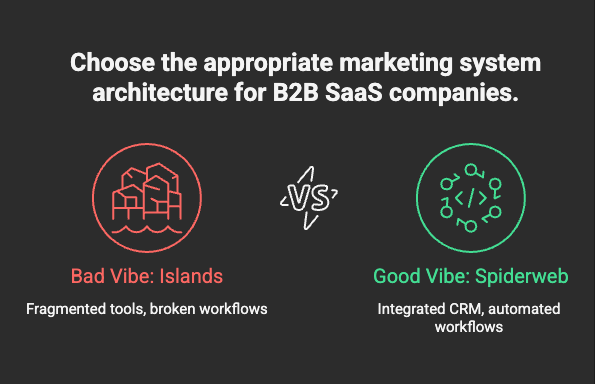
If you see a spiderweb of connections, that’s a good operational vibe. If you see isolated islands with no lines between them, that’s a problem.
When I worked with a SaaS company struggling with 11 disconnected tools, we consolidated to 5 integrated systems. Lead response time dropped from 48 hours to 2 hours. That’s operational vibe.
The lead journey audit
Create a test lead. Go through your entire funnel. Fill out the contact form. Note: How long until the confirmation email? Check: Did lead appear in CRM? How long? Track: What email sequences triggered? Relevant? Follow the entire journey a real developer would take.
Count friction points: Broken links, delayed responses, irrelevant emails, manual handoffs, duplicate communications.
Each friction point damages your vibe. Each smooth interaction builds it.
The promise-reality gap analysis
List your top 5 marketing claims. Now, honestly rate your operational delivery on each (1-10 scale).
| Marketing Claim | Operational Reality (1-10) | Gap |
|---|---|---|
| “Best-in-class support” | 6 (response: 48h average) | 4-point gap |
| “Seamless integrations” | 5 (12 tools via Zapier, no native APIs) | 5-point gap |
| “Comprehensive docs” | 4 (screenshots from v2.0, now on v4.2) | 6-point gap |
| “Enterprise security” | 7 (SOC 2, but 18 months old) | 3-point gap |
If any claim is 3+ points above reality, you have a vibe problem. Prospects will discover the gap. When they do, they’ll assume everything else is exaggerated.
Building better marketing systems
You don’t need more tools. You need better systems.

Start with integration, not addition
Before buying another marketing tool, map your current stack. Pick your central data hub – usually CRM (HubSpot, Pipedrive, Salesforce) as a single source of truth. Connect all tools to the hub with priority on native integrations over Zapier over manual (eliminate manual). Test data flow bidirectionally by creating a test lead and verifying sync across all systems. Document the system architecture by mapping data flows and recording configurations for when the team changes.
The rule: New tools are added only if they integrate with the hub. No more islands.
Implement operational SLAs
You don’t need a huge team to have operational standards. Set clear SLAs and hit them consistently.
Set response targets you can actually hit. Demo requests should get a reply within 24 hours – that first interaction matters. Support tickets need a first response within 48 hours if you’re claiming “great support.” Documentation updates should happen within a week of any release. Even 2 posts per month signals you’re consistently active.
Pick realistic SLAs and hit them consistently. A 24-hour response, you actually hit beats a “we respond immediately!” promise you miss constantly.
Fix the founder-led marketing trap
This pattern kills the vibe every time:
The founder handles all marketing personally. Emails, content, demos. Everything feels responsive and authentic. Great vibe.
Then product demands pile up. Marketing dies. Leads go unanswered. Terrible vibe.
So they hire a junior marketer who doesn’t understand the product. The vibe shifts. Different, usually worse.
The solution isn’t hiring faster. It’s building systems that preserve founder insight while enabling delegation.
Systematize these workflows: Most common demo talking points become a demo script. Typical sales conversations become email templates. Product positioning becomes a documented messaging framework. Customer insights become case study templates.
This isn’t about losing authenticity. Customers trust companies 64% more when the founder is behind the marketing. It’s about building workflows that scale the good vibe without the founder becoming a bottleneck.
What a good operational vibe looks like in practice
Pattern recognition from companies that got this right:
Stripe – Used by millions of developers, $95B+ valuation. Documentation is updated on the same day as releases. API responses are predictable and well-documented. Support actually responds (and knows the product). Pricing page matches what Sales quotes. Their operational coherence IS their marketing.
Twilio – $21B market cap, 50%+ of Fortune 500. Free tier with generous limits (not gotcha pricing). 24/7 developer support (actually 24/7). Code samples that work (copy-paste ready). Community forums with real answers. Bottom-up adoption because developers trust them.
MongoDB – $35B+ market cap, 100k+ developers. Open-source first (community trust). University partnerships (developer education). Hands-on workshops (learn by doing). Documentation that assumes you’re technical. Enterprise migration happened bottom-up.
The pattern: Systems work. Promises match reality. Execution is consistent. Technical buyers notice.
Why does this create a competitive advantage?
Most B2B SaaS strategies compete on features. Features are table stakes. Your competitor will copy your features in 6 months.
Operational vibe is harder to copy because it requires systems thinking (not just tool buying), consistent execution (not just good intentions), and organizational discipline (not just marketing budget).
I’ve watched technical founders evaluate tools. Two products, similar features, same price range.
First company: Gorgeous website. Impressive demo. But documentation references features that don’t exist in the trial. Sales follow-up arrives three days late. Promised information never arrives.
Second company: Website is fine. Demo works flawlessly. Confirmation email arrives within minutes. Documentation is current. Calendar invite scheduled exactly when requested.
Guess which one gets adopted?
The operational competence evident in the buying process directly translates into product confidence.
Vibe marketing is systems marketing
Your brand vibe isn’t your color palette. It’s your operational reality.
Vibe marketing for technical products means marketing tools that communicate (spiderweb, not islands). Brand promises that match operational delivery. Consistent execution at every developer touchpoint. Systems that work without manual intervention from the founder. Documentation that’s actually current. Support that actually responds.
While Salesforce focuses on emotional connections, Exploding Topics sells AI tools, and technical products need operational coherence.
The companies winning in B2B technical markets – Stripe, Twilio, MongoDB, GitHub – aren’t the ones with the biggest marketing budgets or the coolest brand aesthetics.
They’re the ones whose operational coherence signals: “We know how to build systems that work. Including our own.”
That’s the vibe technical buyers trust.
Frequently asked questions
Next steps
Audit your current systems (use the three tests above). Identify your biggest vibe killer (probably system integration or execution consistency). Fix one thing completely (better to fix one system than half-fix five). Document it (so it stays fixed when you hire/scale). Repeat.
Your marketing vibe is a systems problem, not a creative problem.
VibeYourMarketing solves systems problems. We audit your stack, identify operational gaps, and build marketing coherence that scales. Fractional CMO leadership + integrated systems that actually work – without the full-time hire.