
You didn’t start a SaaS company to become a marketer.
You built something that solves a real problem. Now you’re supposed to master SEO, content marketing, LinkedIn, paid ads, email sequences, and account-based marketing. While shipping features, managing a team, and avoiding burnout.
Every month without a system, you’re losing deals to competitors who have one.
Most B2B SaaS marketing advice is written for marketers. This guide is different. It’s for founders and marketing leads who need marketing that actually works, not more tactics to try. No agency fluff. No 47-tactic listicle. Just the systems approach that turns marketing from chaos into a machine that runs without constant attention.
- Systems beat tactics – Random marketing activities don’t compound. A system does.
- Founders are the best early marketers – You know the product and customer better than any hire. Use that advantage.
- Hire after you’ve proven it works – Document what converts before handing it off. Otherwise, you’re hiring someone to discover what you already know.
- Most first marketing hires fail – Not because of bad hires. Because they inherit chaos instead of a system.
Why most B2B SaaS marketing fails
The pattern is painfully common. A founder hires an agency. Spends $5-15k per month. Gets reports full of impressions and engagement metrics. But no leads. No pipeline. After six months, fires the agency and is back to square one, except now with less runway and more skepticism.
This happens because agencies don’t understand your technical product. They apply cookie-cutter strategies designed for consumer brands. They optimize for metrics they can show on a dashboard, not outcomes that move your business.
The same pattern plays out with in-house hires. A founder gets overwhelmed doing marketing alone. Hires a junior marketer or marketing generalist. Expects them to “figure it out.” Three months later, still no system, still no results, except now there’s a salary to pay.
The contrarian truth? Early-stage founders are the best marketers for their own companies.
Think about it:
- You know the product deeply. Every feature, every edge case, every reason it exists.
- You know the customer pain. You’ve talked to them. You built the solution to their problem.
- You can iterate on messaging fast. No approval chains. No brand guidelines reviews. Just ship and learn.
A marketing hire needs 3-6 months to learn what you already know. They’ll spend that time interviewing customers, understanding the product, and figuring out what resonates. All the work you’ve already done.
The problem isn’t that you shouldn’t hire marketers. The problem is when you hire them. The best time to hire is after you’ve proven the messaging and channels work. Then you’re handing off a system, not asking someone to build one from scratch.
Want to go deeper on this approach? Read about founder-led marketing systems that scale without burning out.
What is B2B SaaS marketing?
B2B SaaS marketing is the practice of marketing software-as-a-service products to other businesses. Simple enough. But the “SaaS” and “B2B” parts create unique challenges that make standard marketing advice irrelevant.
How B2B SaaS compares to other models:
| Characteristic | B2B SaaS | Consumer SaaS (Spotify, Notion) | B2B Traditional (agencies, consulting) |
|---|---|---|---|
| Revenue Model | Recurring (MRR/ARR) | Recurring or one-time | One-time or project-based |
| Sales Cycle | Weeks to months | Minutes to days | Months to years |
| Buyer Psychology | Evidence over emotion | Emotion and convenience | Relationships and trust |
| Marketing Focus | Retention + acquisition | Acquisition + virality | Acquisition + relationships |
The recurring revenue model changes everything. You’re not just marketing for acquisition. You’re marketing for retention. For expansion. For the entire customer lifetime. A customer who churns after three months costs you money, even if they paid upfront.
Long sales cycles mean multiple touchpoints. Your potential customers will read your blog, check your documentation, try your free trial, read reviews, compare alternatives, and possibly loop in their team before making a decision. Marketing isn’t a single event. It’s a journey you guide your target audience through.
Technical buyers in your target audience require evidence. They don’t respond to hype. They want to see the product work. They want proof from companies like them. They’ll check your GitHub repo before your pricing page.
B2B SaaS marketing examples that worked
Let’s look at SaaS companies that built marketing systems, not just executed tactics.
Slack: Product-led growth pioneer. Slack’s marketing strategy was barely marketing in the traditional sense. Free tier with generous limits. Strong onboarding that got teams using the product within minutes. Viral loop where every team member became an evangelist. The product was the marketing.
Atlassian: SEO-first, developer community, bottom-up. Atlassian built a multi-billion dollar business through bottom-up enterprise adoption. Their marketing focused on developers first. SEO content that answered real questions. A marketplace ecosystem that extended its products. No outbound sales team until they hit serious scale. Their self-serve model drove enterprise adoption from the ground up.
HubSpot: Inbound methodology, free tools as lead gen. HubSpot didn’t just use inbound marketing. They invented the term. Free CRM. Free marketing tools. Massive educational content library. Every tool was a lead generation mechanism that demonstrated its core thesis: inbound works.
What these companies have in common:
- Marketing is integrated with the product, not separate from it.
- Systems that scaled without proportional headcount
- Long-term thinking over quick wins
Now, you’re probably not building the next Slack. Most of us aren’t. But the principles apply at every stage:
- Focus on one channel until it works. Atlassian dominated SEO before expanding. Slack perfected product-led growth before anything else.
- Prove messaging before hiring. HubSpot’s founders created the inbound content themselves before building a team.
- Build systems that can run without you. All three companies built machines, not just campaigns.
Building your B2B SaaS marketing system
This is where most advice fails you. Marketers love tactics. “Try this LinkedIn strategy.” “Use this 47-step email sequence.” “You need account-based marketing.”
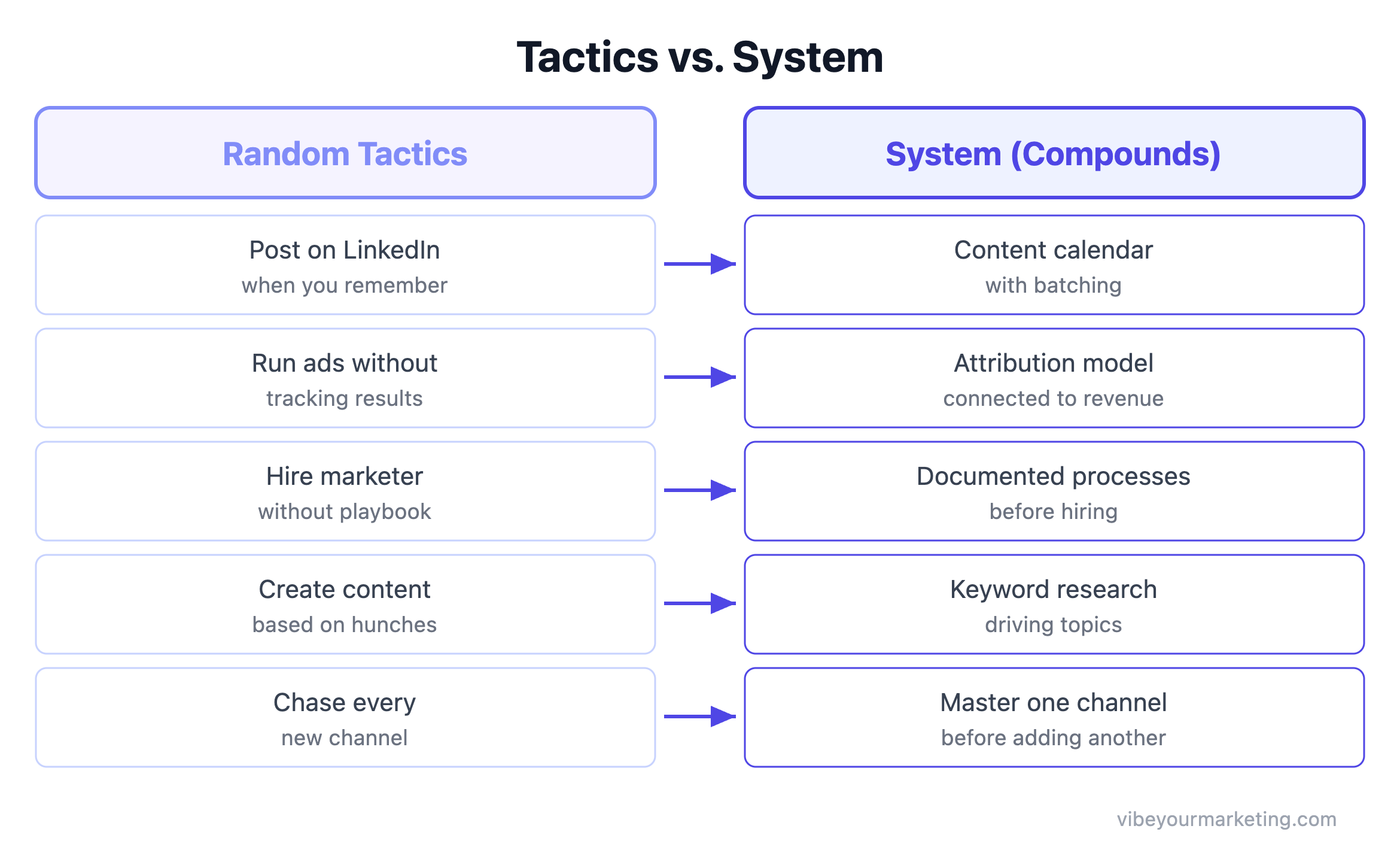
Tactics without systems don’t compound. They create spikes.
| Tactics (Random) | System (Compounds) |
|---|---|
| Post on LinkedIn when you remember | Content calendar with batching |
| Run ads without tracking | Attribution model connected to revenue |
| Hire marketer without playbook | Documented processes before hiring |
| Create content based on hunches | Keyword research driving topics |
| Chase every new channel | Master one channel before adding another |
One-off actions give you peaks in metrics. More sessions. Higher conversion. But after a week, you’re back to baseline. Without a system running in the background, you’re constantly chasing the next spike.
The foundation-first approach:
Think of your marketing as two layers:
- Foundation layer (always running): SEO and SEM that provide a steady user flow. Content that ranks and compounds over time. These aren’t exciting. They don’t create viral moments. But they’re the machine that runs while you sleep.
- Agile layer (add and remove): Growth experiments. Email campaigns. Social media pushes. LinkedIn content. You can add these, test them, remove them based on results. But only because the foundation is handling baseline traffic.
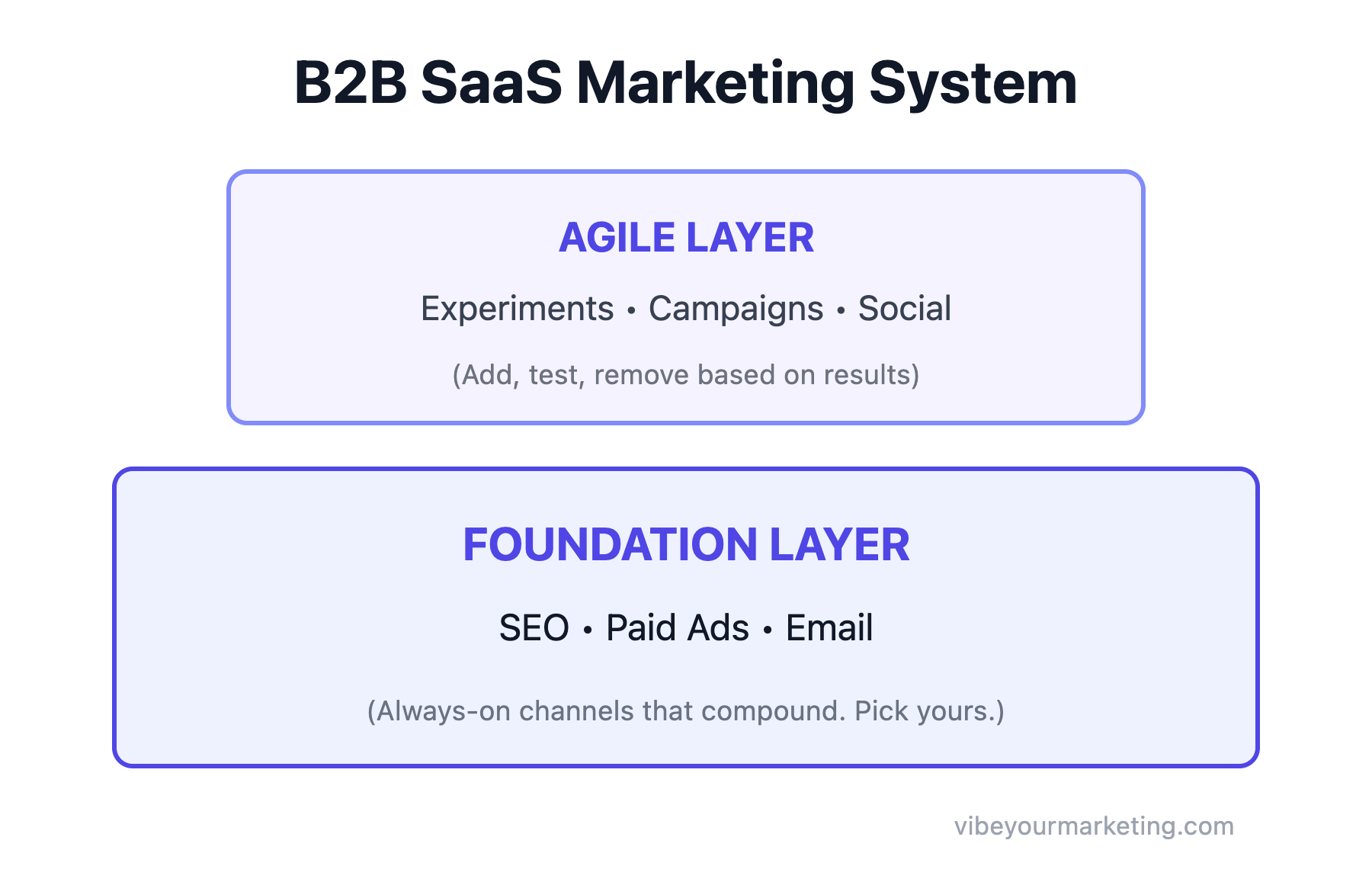
Without the foundation, you get chaos. Every week is spent scrambling for the next tactic. Team burnout is inevitable because there’s no system generating results, just people running faster.
When to stay founder-led:
- Pre-product-market fit: Always. You need direct customer feedback loops. Marketing hires add distance.
- Pre-$1M ARR: Mostly. You’re still learning what resonates. Document everything.
- Pre-$5M ARR: Strategic direction stays with founder. Execution can shift to the team.
The goal isn’t to do marketing forever. The goal is to build a system you can hand off. That’s the difference between a founder who’s trapped in marketing and a founder who’s built vibe marketing for technical products that runs without them.
The B2B SaaS marketing funnel
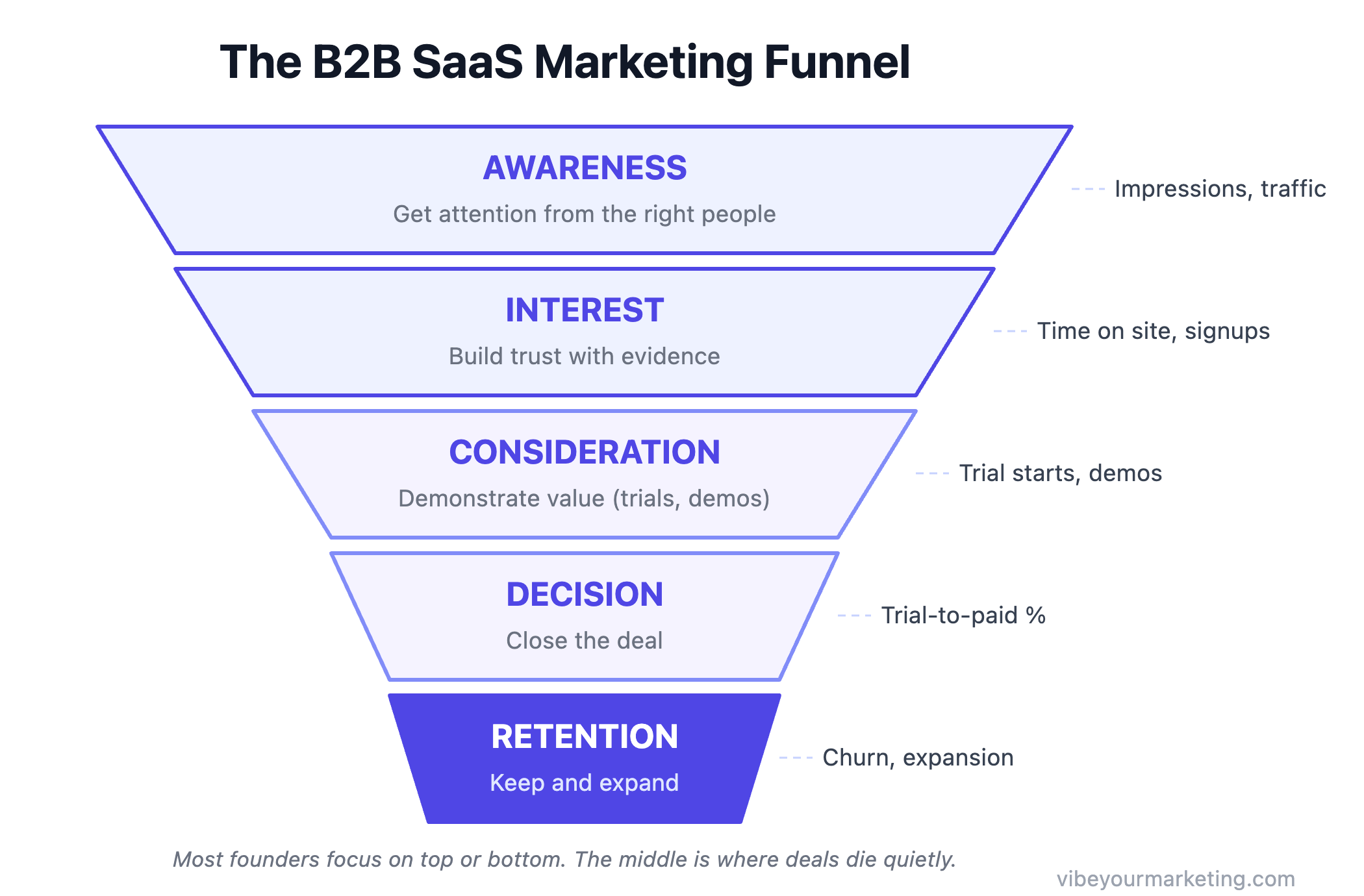
Every SaaS company has a funnel, whether they’ve mapped it or not. Understanding yours is the first step to improving it.
| Stage | Goal | Key Metric |
|---|---|---|
| Awareness | Get attention | Impressions, traffic |
| Interest | Build trust | Time on site, email signups |
| Consideration | Demonstrate value | Free trial starts, demo requests |
| Decision | Close the deal | Trial-to-paid conversion |
| Retention | Keep and expand | Churn rate, expansion revenue |
Most founders focus on the top (awareness) or the bottom (closing). The middle stages are where deals die quietly.
The Rule of 40: Growth rate + profit margin should equal at least 40%. A company growing 30% annually with 10% profit margin hits 40%. A company growing 50% with -10% margin also hits 40%. This rule helps you balance growth investment against sustainable economics.
Key SaaS benchmarks to track:
- CAC payback under 18 months: The median private SaaS company takes 20 months to recover acquisition cost. Bessemer considers 12-18 months “good” and under 12 months “better.”
- LTV:CAC ratio of 3:1 or higher: Your customer lifetime value should be at least 3x what you spent to acquire them. The 2024 median hit 3.6:1. Below 3:1 means you’re overspending.
- Gross retention around 90%: Retaining 9 out of 10 customers (by revenue) is standard. Net retention above 100% means expansion revenue covers churn.
Quick check: Which stage is your biggest bottleneck right now? If you don’t know, that’s your first problem to solve. You can’t fix what you can’t measure.
B2B SaaS marketing channels that actually work
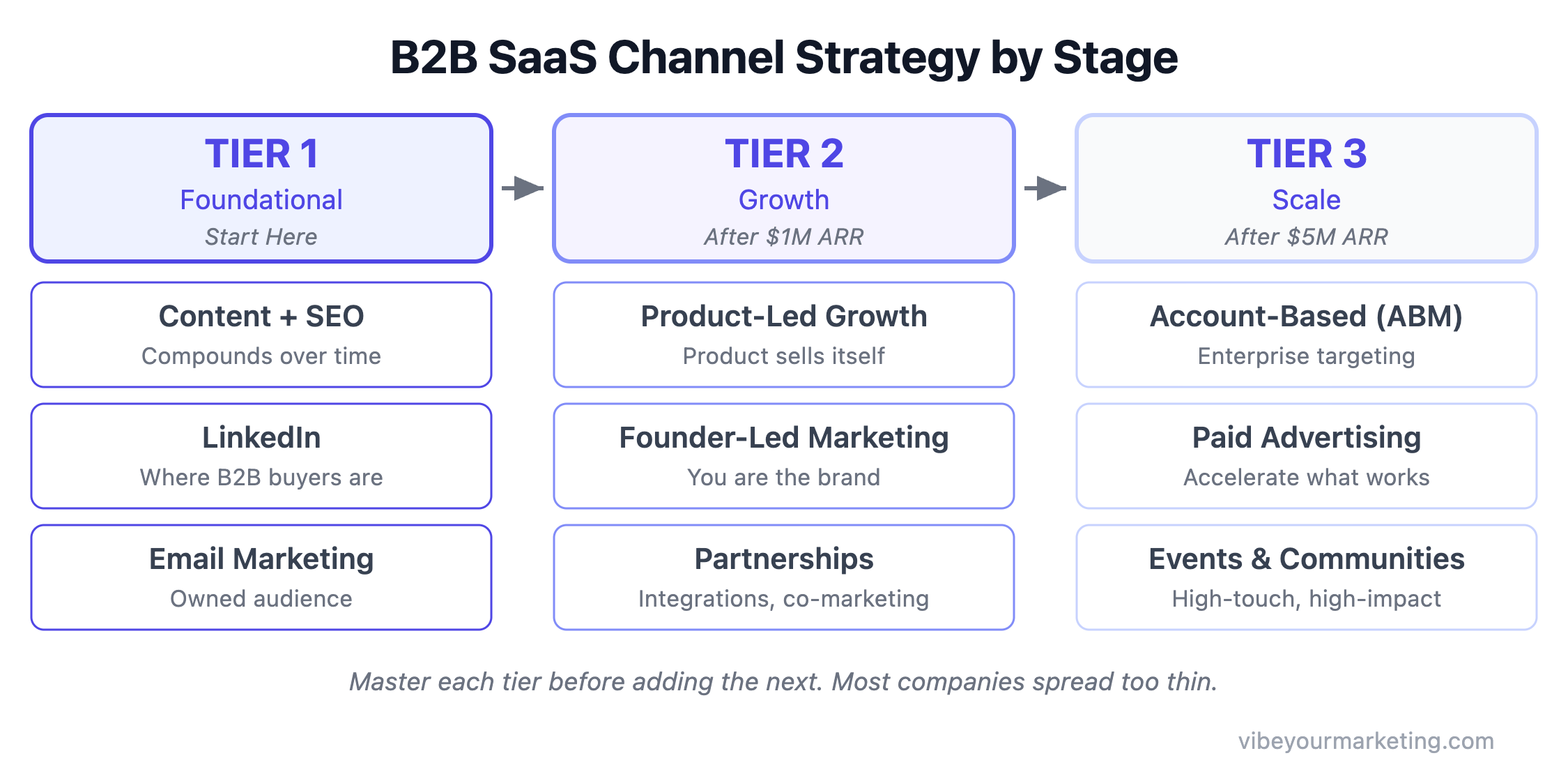
Every “complete guide” lists 19 channels and tells you to pick the ones that work. That’s useless. Here’s a tiered approach based on company stage.
Tier 1: Foundational (Start Here)
- Content marketing and SEO: B2B companies that prioritize blog content consistently outperform those relying on paid channels alone. SEO compounds. Paid ads stop working when you stop paying.
- LinkedIn: For B2B SaaS, LinkedIn is where your buyers actually spend time. Organic content for thought leadership. Targeted ads for specific accounts or personas.
- Email marketing: Owned audience beats rented reach. Every follower on social media is borrowed. Every email subscriber is yours.
Tier 2: Growth (After $1M ARR)
- Product-led growth: Many B2B SaaS companies now use this as their primary acquisition channel. Free tiers, trials, and self-serve onboarding that let the product sell itself.
- Founder-led marketing: At early stages, you are the brand. Your perspective, your story, your expertise. This doesn’t scale forever, but it’s powerful for $1-10M companies.
- Partnerships and integrations: Being in someone else’s ecosystem (app marketplaces, integrations, co-marketing) puts you in front of qualified buyers.
Tier 3: Scale (After $5M ARR)
- Account-based marketing: ABM is increasingly popular among larger SaaS companies targeting enterprise accounts. But ABM requires resources. Don’t start here.
- Paid advertising: Google and LinkedIn ads work, but they’re expensive. Use them to accelerate what’s already working, not to find what works.
- Events and communities: Conferences, webinars, user communities. High-touch, high-effort, high-impact when done right.
The framework: Master Tier 1 before adding Tier 2. Master Tier 2 before adding Tier 3. Most companies spread too thin across all three and master none.
B2B SaaS marketing metrics that matter
You can drown in metrics. These five tell you if your marketing is working. The benchmarks below come from 800+ SaaS companies surveyed by OpenView/High Alpha, Bessemer Venture Partners, and KeyBanc/Sapphire Ventures.
| Metric | What it measures | 2024 Benchmark |
|---|---|---|
| LTV:CAC Ratio | Customer lifetime value vs. acquisition cost | 3:1 minimum, 3.6:1 median |
| CAC Payback | Months to recover acquisition cost | 20 months median (6-12 for top performers) |
| Gross Retention | % revenue kept without expansion | ~90% |
| Net Retention | % revenue kept including expansion | 101% median, 115-125% top performers |
| ARR Growth | Year-over-year revenue growth | 19-21% median, 27-32% top quartile |
The LTV:CAC relationship: You need at least 3:1 for the math to work. Below that, you’re spending too much to acquire customers. Above 5:1, you might be under-investing in growth. The 2024 median across private SaaS hit 3.6:1.
CAC payback reality check: The median private SaaS company takes 20 months to recover customer acquisition cost. That’s down from 25 months in 2022, but still longer than many founders expect. Bessemer rates 12-18 months as “good,” 6-12 months as “better,” and under 6 months as “best.”
What to track first: Don’t boil the ocean. Start with two metrics:
- CAC: What does it cost to acquire a customer through each channel?
- Net retention: Are existing customers staying and expanding?
Everything else builds from there. Companies that pair high net retention with efficient CAC nearly double their growth rates vs. those with weaker retention.
What makes B2B SaaS marketing unique (and harder)
Generic B2B marketing advice fails for SaaS because it ignores the specific challenges of business buyers and subscription models.
Multiple stakeholders: The person who discovered your product usually isn’t the one who signs the check. They need to convince finance (budget), leadership (strategic fit), and sometimes legal or IT. Your marketing needs to give internal champions the ammunition to sell internally: case studies, ROI data, security docs, whatever their colleagues will ask for.
Bottom-up adoption: End users often try tools before procurement gets involved. Many B2B SaaS deals start with a single user or team falling in love with the product. Your free tier, trial experience, and onboarding are marketing channels, not just product features.
Proof over promises: B2B buyers do their homework. They check reviews on G2 and Capterra. They ask peers in Slack communities. They read case studies and test your product before ever talking to sales. Marketing that relies on claims without evidence gets ignored.
Trust takes time: In consumer marketing, the right offer can close a sale in minutes. In B2B SaaS, trust builds over weeks or months. Buyers need to see the product work, read about similar companies, and feel confident before committing. Your marketing builds credibility long before purchase intent exists.
Consumer tactics and traditional B2B playbooks don’t translate here. Different buyer psychology. Different timeline. Different proof requirements.
What would change?
If you treated marketing as a systems problem instead of a tactics problem, what would change in your company?
Look at where you are now. Compare it to the frameworks in this article. Where are the gaps?
Maybe you need to build the foundation before adding more tactics. Maybe you need to stop hiring and start documenting what works. Maybe you need to understand your metrics before optimizing anything.
B2B SaaS marketing isn’t about doing more. It’s about building systems that do the work for you.
B2B SaaS marketing isn’t about doing more. It’s about building systems that do the work for you.
Frequently Asked Questions (FAQ)
References
- OpenView + High Alpha – 2024/2025 SaaS Benchmarks Report. Data from 800+ SaaS companies on CAC, LTV, retention, and growth metrics.
- Bessemer Venture Partners – State of the Cloud 2024. Industry-standard benchmarks including CAC payback Good/Better/Best framework.
- KeyBanc Capital Markets + Sapphire Ventures – 15th Annual Private SaaS Company Survey (2024). 100+ private SaaS companies, median $26M ARR.