
Consumers trust companies with visible leadership. But what if you’re a technical founder who builds products, not marketing campaigns?
The pattern is common: the founder handles all marketing, gets overwhelmed, hires someone, and the chaos continues. The real problem isn’t the founder or the hire. It’s treating marketing as tasks instead of systems.
Some founders generate millions in revenue from content alone. Others get hundreds of sign-ups monthly just from LinkedIn.
Most founder-led marketing advice assumes you’re a marketer. This playbook is for builders. If marketing’s been on your to-do list for six months, you’re in the right place.
- Founder-led marketing works when treated as a systems problem, not a communication challenge. Apply the same thinking you use to build products.
- Real outcomes matter: Chris Walker built an 8-figure company through content, Peter Caputa gets hundreds of monthly sign-ups from LinkedIn. This isn’t just “building trust.”
- Technical founders have a hidden advantage: domain expertise plus systems thinking. You already solve communication problems daily through docs, support, and sales. Marketing is the same skill on a different scale.
- The 3-pillar content mix: 65% authority (technical depth), 25% personal (journey/learnings), 10% sales (product updates). Trust before selling.
- Transition framework prevents burnout: start with the founder doing everything (pre-PMF), move to founder strategic + team execution ($1M-$10M ARR), scale to founder-directed brand ($10M+). Fractional leadership fills the gaps.
What is founder-led marketing (and why it matters for technical founders)
Founder-led marketing is when the founder becomes both the public face and the strategic marketing decision-maker. Not just “be active on LinkedIn.” Not personal branding. You’re building company authority through founder credibility.
For technical products, this matters because technical buyers trust maker credibility over brand polish. When the person who built it explains it, that’s an authenticity signal competitors can’t fake. You already have domain expertise. The competitive advantage is translating it into content.
The technical founder advantage most advice misses: you’re already a systems thinker. You fix processes, then automate them. Marketing is the same pattern. Most founders fail because they try to “do marketing” instead of “build marketing systems.”
This systems approach is what we call vibe marketing for technical products: your operational reality matching your marketing promises.
Think about how you approach product development. You don’t write code randomly and hope it works. You architect systems, document processes, and build for scale. Apply that same mindset to marketing.
The real benefits (beyond “building trust”)
Everyone says founder-led marketing “builds trust.” True, but vague. What actually happens when you do this right?
Revenue you can attribute
Chris Walker (Refine Labs → Passetto): Built an 8-figure B2B company in 3 years using LinkedIn content and podcasts. Not brand awareness. Direct revenue attribution.
Peter Caputa (Databox): Around 100 free trial sign-ups per month from “building in public” LinkedIn posts. Passive inbound leads daily. No paid ads.
Cassey Ho (POPFLEX): 25 million views on a TikTok design video. Product sold out within hours. One piece of content created instant demand.
Notice the pattern? These aren’t vanity metrics. They’re business outcomes. Founder-led marketing works because it shortens the timeline for building trust. Instead of prospects evaluating your brand through ads and landing pages, they evaluate you directly.
The trust economics
Leaders who use social media are trusted 6x more than those who don’t (Brunswick research). For technical products, this effect is stronger. Technical buyers are skeptical of marketing claims. Founder visibility signals “skin in the game.”
When you explain your technical decisions publicly, you demonstrate operational coherence. Your product promises match your actual capabilities. That’s what technical buyers evaluate. They’re not buying your messaging. They’re buying your competence.
Competitive moat
Competitors can copy your features. They can’t copy your founder story or domain expertise. In saturated markets, trust becomes the differentiator. Your unique perspective, built over years in the industry, creates a moat that’s harder to replicate than product functionality.
This compounds over time. Every piece of content adds to your authority. Your content library becomes an asset that keeps working while you build a product.
Why founder-led marketing breaks (and how to fix it)
Three failure modes kill founder-led marketing. The good news? Technical founders are uniquely positioned to fix all of them.
1. Time drain
Pattern: Founder writes everything, burns out after three months, quits posting. Root cause? Treating marketing as tasks instead of systems.
The fix: Content batching. Spend 2 hours each quarter planning 12 topics. Record twelve 5-minute Loom videos explaining each. Your marketing team transcribes, edits, and publishes. You spend 10 strategic hours per week (on topic selection and approval), not 40 execution hours.
This is the same pattern you use in product development. You don’t write every line of code. You architect the system, document the requirements, and enable the team to execute.
2. The “I’m not a marketer” objection
Most technical founders resist founder-led marketing because “I’m not a marketer.” Fair enough. But reframe the problem.
You already solve communication problems daily. Documentation explains complex technical concepts. Support tickets require translating engineering decisions into customer language. Sales demos show product value to non-technical buyers. That’s marketing. You’re already doing it.
The psychological barrier is real: fear of saying something wrong publicly, imposter syndrome (“who am I to teach?”), time scarcity. All legitimate. The solution isn’t “get over it.” The solution is systems that reduce friction.
If writing feels hard, don’t write. Record 5-minute videos explaining problems you’ve solved. Your team extracts quotes, creates graphics, and publishes to LinkedIn. You spend 5 minutes. They handle the rest.
3. No handoff strategy
Founder-led marketing fails when you can’t transition to a team. If the playbook lives in your head, you’re stuck doing everything forever. That’s not sustainable.
Fix this from day one: Document your process. Create templates. Build repeatable frameworks. When you write a LinkedIn post that performs well, turn it into a template. When you explain a technical concept effectively, document the structure. This lets you move from doing to directing.
Real examples: what works (and what doesn’t)
Case studies reveal patterns. These three founders took different approaches. All succeeded, but the platform choices and execution strategies varied significantly.
Case study: Chris Walker (Passetto)
Platform: LinkedIn, podcasts, long-form blog content
Approach: Thought leadership on demand generation and go-to-market strategy
Result: 8-figure revenue in 3 years, directly attributed to content
What made it work: Consistent systems, not one-off posts. He follows a 3-pillar content architecture: 65% authority content (frameworks, how-tos), 25% personal content (company journey, learnings), 10% sales content (product updates, case studies). Trust before selling.
Technical founders can replicate this. You have authority content (how you solve technical problems). Personal content (why you built the product). Sales content (customer wins). The structure already exists. You just need a system to publish it consistently.
Case study: Peter Caputa (Databox)
Platform: LinkedIn transparency posts
Approach: Share metrics, learnings, behind-the-scenes operational decisions
Result: ~100 monthly sign-ups, passive inbound leads daily
What made it work: Radical transparency. The founder treats founder-led marketing as audience-building, not just lead generation. He publishes company metrics, strategic decisions, and lessons learned. This creates direct customer feedback loops. Prospects see the operational reality before they buy. For technical products, this transparency builds credibility faster than polished campaigns.
Case study: Cassey Ho (POPFLEX) – the contrast
Platform: TikTok design-with-me series
Result: 25M views, product sold out in hours
What made it work: Community co-creation. She brings her audience into the design process in real-time. But notice the difference: this approach works for consumer brands. B2B technical buyers need depth, not viral content. They evaluate operational competence, not aesthetic appeal.
Platform comparison for technical founders:
| Platform | Best For | Not For |
|---|---|---|
| B2B technical products, thought leadership, decision-maker reach | Consumer viral content, rapid-fire engagement | |
| Blog/Long-form | Technical depth, SEO authority, complex explanations | Real-time conversations, immediate feedback |
| Twitter/X | Technical discussions, developer community, quick insights | Polished campaigns, formal positioning |
| TikTok/Instagram | Consumer products, visual storytelling, younger audiences | B2B SaaS, technical product explanations |
Platform choice matters. Match the platform to your audience, not the trend. Most technical founders default to LinkedIn and blog content. That’s correct for B2B SaaS Marketing.
The systems approach: how to actually start
You don’t need a marketing background. You need a framework. Apply systems thinking to founder-led marketing the same way you architect products.
The founder story arc framework
Every technical founder has four components that translate directly into content:
1. Problem you saw (technical insight from your domain)
2. Solution you built (product journey, technical decisions)
3. Why it matters (mission, impact on customers)
4. Proof it works (metrics, customer outcomes)
Template for any post: “I noticed [problem] while [context]. We built [solution] to [outcome]. The key insight: [learning].”
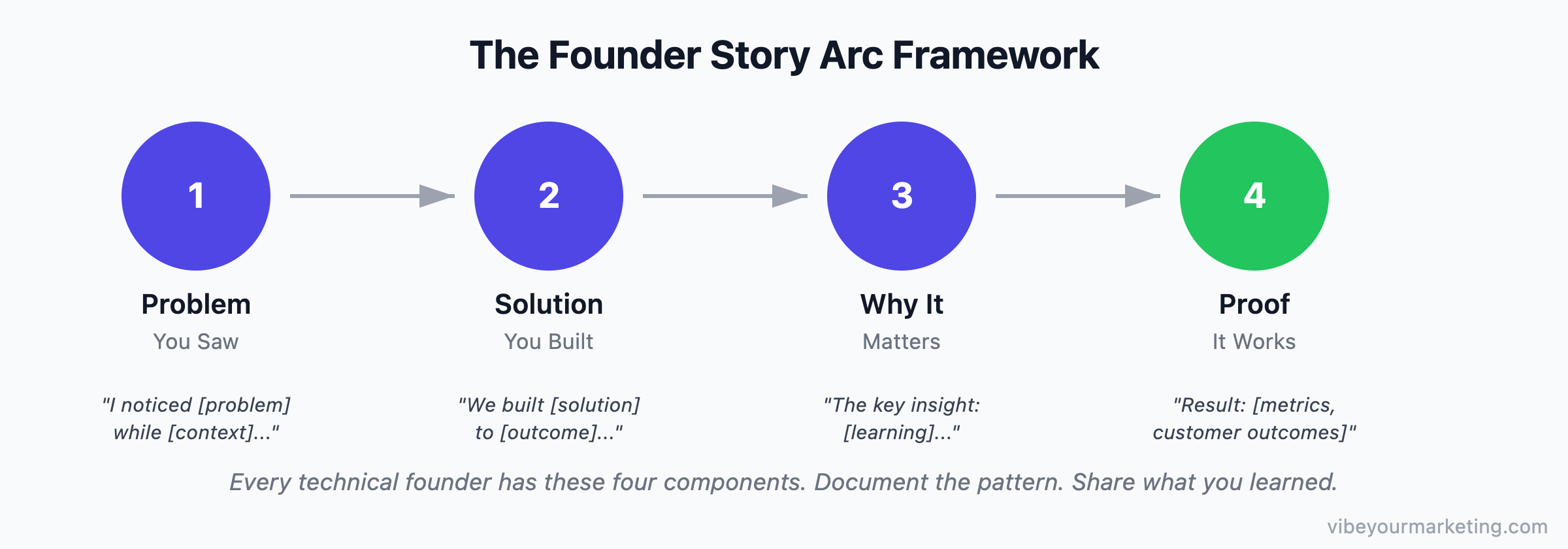
This isn’t “storytelling.” It’s pattern recognition. You solve problems. Document the pattern. Share what you learned. That’s founder-led marketing.
Content architecture (the 3-pillar system)
Don’t post randomly. Follow a proven structure:
65% Authority content: Technical depth, how-tos, frameworks, problem-solving. This builds credibility. Show you understand the domain.
25% Personal content: Company journey, learnings, behind-the-scenes decisions. This builds a connection. Show you’re human.
10% Sales content: Product updates, case studies, customer wins. This converts. Show proof it works.
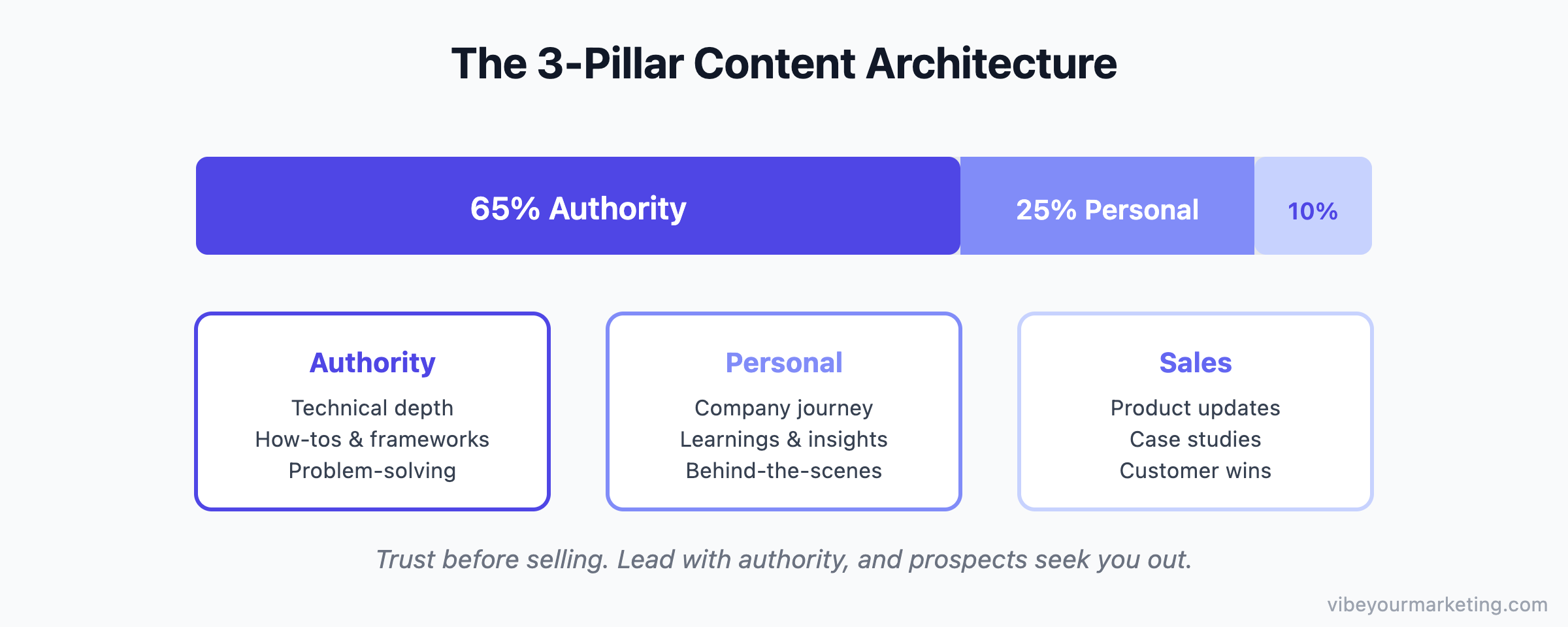
Why this ratio? Trust before selling. If you lead with sales content, you’re just another vendor. Lead with authority, and prospects seek you out.
Batching system
Most founders quit because founder-led marketing feels like a full-time job. It’s not. You’re just doing it inefficiently.
Quarterly content sprint (2 hours):
- List 12 topics: product insights, customer problems you solved, and technical decisions.
- Record 12 five-minute Loom videos explaining each topic
- The marketing team transcribes, edits, creates graphics, and schedules posts.
- You review and approve (30 minutes per week)
Result: 12 weeks of content from 2 hours of founder time. Your role becomes strategic (topic selection, approval), not execution (writing, design, distribution).
Founders who systematize content production consistently outperform those who post randomly. Not because they post more. Because they removed the friction.
Minimal viable stack
You don’t need expensive tools. Start with what works:
Content creation: Google Docs (writing) + Loom (video recording). Both free.
Distribution: Buffer or Hootsuite for scheduling ($10-50/month).
Analytics: Platform-native analytics (LinkedIn, Twitter built-in). Don’t over-engineer.
Integration matters more than features. Your CRM should know when someone engaged with your content. Your email platform should segment based on content interest. Data flows between tools. That’s operational coherence.
What NOT to automate: Founder voice. Use AI to edit and format, not to write. Technical explanations require your expertise. Customer conversations build relationships. Automate distribution and data syncing. Don’t automate thinking.
When founder-led marketing isn’t right (and how to know)
Not every founder should do this. Not every company needs this. Be honest about fit.
Founder type assessment
| Good Fit | Poor Fit |
|---|---|
| Technical founders with domain expertise | Founders who hate public visibility (legitimate preference, not just fear) |
| Founders willing to share learnings publicly | Consumer products requiring viral content (different playbook) |
| Stage: Pre-PMF to $10M ARR | Highly regulated industries with compliance constraints |
| Industries: B2B SaaS, DevTools, APIs, technical infrastructure | Post-IPO companies with complex stakeholder dynamics |
Stage appropriateness
Pre-PMF (Product-Market Fit): Founder-led is essential. You’re the credibility signal. Prospects buy because they trust you understand the problem.
$1M-$10M ARR: Transition to founder-directed. You provide strategic direction (topics, positioning). Team handles execution (writing, design, distribution). Fractional marketing leadership fills gaps.
$10M+ ARR: Team-led with founder input. Brand is established. The founder participates strategically but isn’t the bottleneck.
The honest assessment: if the idea of sharing publicly drains you (not just scares you initially), this isn’t your marketing channel. Build through partnerships, product-led growth, or traditional demand gen. All valid paths.
Scaling beyond yourself
The transition from founder-dependent to team-driven marketing determines whether you scale or burn out.

Phase 1: Founder does everything (pre-PMF)
You are the brand. Every post, every demo, every customer conversation. This is correct at this stage. Goal: prove product-market fit. Your personal credibility carries the company while you find repeatable traction.
Phase 2: Founder strategic + team execution
Founder role (10 strategic hours/week):
- Quarterly content planning: pick topics, approve positioning
- Review and approval: team drafts, you edit and approve
- Key customer conversations: you still handle strategic accounts
Team role: Execution. Writing, design, distribution, analytics. They implement your documented playbook.
Fractional marketing leadership fills gaps: Systems design, team hiring, strategic planning. You don’t need a full-time CMO at $200K+. You need focused strategic hours from someone who’s done this before, at a fraction of full-time cost. That’s the fractional model.
Phase 3: Founder-directed brand (scale)
Founder remains public face. Team owns execution completely. Systems are documented and repeatable. New team members can execute the playbook without constant founder involvement.
This is how Chris Walker scaled Passetto to 8-figure revenue. He’s still the face of the brand. But the team runs content production, distribution, and optimization. He focuses on strategic direction.
Balancing personal vs company brand
The distinction matters. Founder-led marketing isn’t personal branding. You’re not building “Founder as Influencer.” You’re building company authority through founder credibility.
Personal: Your insights, journey, technical perspective
Company: Product updates, customer wins, team highlights
Boundary: Share company-building lessons. Keep personal life private unless directly relevant.
Goal: when someone follows you, they’re following because they trust your expertise, not because they’re fans of your lifestyle. That expertise builds company brand authority.
When to transition: Revenue at $1M ARR (you can afford fractional or team support). Time commitment over 20 hours per week (unsustainable). Team readiness (someone can execute your documented playbook).
The bottom line
Founder-led marketing works when you treat it as a systems problem, not a communication challenge. Technical founders have the advantage: domain expertise plus systems thinking. You already solve communication problems daily through documentation, support, and sales. Marketing is the same skill at different scale.
Start small. Pick the Founder Story Arc framework. Batch content quarterly. Use the 3-pillar mix (65% authority, 25% personal, 10% sales). Document your process. Build for transition from day one.
Most founder-led marketing advice targets marketers. This playbook is for builders. You don’t need a marketer’s mindset. Apply the engineering approach you already use.
Systems that work, not marketing that looks good. That’s what we call vibe marketing for technical products. When your marketing systems have operational coherence, the brand feeling follows naturally.
Get marketing handled
Your marketing vibe is a systems problem. VibeYourMarketing solves systems problems.
We’ll audit your current marketing stack, identify the operational gaps, and build marketing coherence that scales. Fractional leadership plus integrated systems that actually work. Strategic direction at a fraction of full-time cost.
For technical founders who know marketing matters but don’t have the bandwidth to figure it out themselves.
Frequently asked questions
References
- Brunswick Research – Social media trust study (via Tribal Impact)
- Marvin Sangines – Chris Walker playbook analysis (LinkedIn)
- The B2B Creator – Peter Caputa’s LinkedIn strategy breakdown
- Kajabi – Cassey Ho interview on building POPFLEX